Diesel price average price for Cape Town, November 2013

BP at Main Road, Muizenberg, Cape Town: R13,10 per litre (50 ppm)

In a typical 35-gallon barrel of light, sweet crude oil the potential is there to make about 16 gallons of petrol, 8,5 gallons of diesel, 3,4 gallons of jet fuel and 8,5 gallons of heavy fuel oil, liquefied petroleum gases and other products...all for around $80!

Wednesday, December 29, 2010

Serendipity and boot-sales


If your disposable income has slowed to a trickle (and your favourite hobby is having to take a back seat) now’s certainly not the time to panic, I reckon.

For those lucky enough to own a garage attached to their property I suspect these days even less man-hours are being spent within those four walls. You, like me have most likely had to postpone getting that classic car tappet cover or motorcycle headlight rim re-chromed because bread and milk are seemingly more important right now.

Take heart! Rule number one: Don’t ever be tempted to sell your pride and joy — your asking price probably wouldn’t be reached, anyhow. No, if I can give you some learned advice: rather bite the bullet, sit tight and do some lateral thinking in your quest to complete that perfect rebuild or refurbishment project.

It’s all about striking the perfect medium. I’m assuming you are a family man so a recent report I recently discovered from the UK would certainly have relevance: the headline recorded: “Museum Numbers are Soaring as Families Look for Free Day Out.”  

Right now most museums over there are attracting anything up to a 40% increase in visitors over last year (well, it is getting near summer and museums grant free admittance!). The survey looked at 300 museums up and down the country, including the Victoria and Albert, Tate galleries and my all-time favourite, the Science Museum in Kensington, London.

I’m not suggesting for one moment that you and your family jump on a plane and do the foreign museum thing next week, but have you been to your local museum lately, for instance? It’s well worth a look — tit’s also an excellent way of entertaining the family when on a shoestring.

Which brings me nicely around to taking the occasional stroll through fleamarkets in this neck of the woods — albeit in a slightly hedonistic way — or searching out those oft-advertised autojumbles. You would be equipped naturally, with an exhaustive parts list, just in case the elusive piece you are looking for just happens to be staring you in the face.

Right now I don’t have a motorcycle or car to work down here in the Mother City — more’s the pity — because I’m discovering some amazing items at fleamarkets and occasional garage sales that are advertised in the local press. I’ve managed to find car books and yet another obscure tool to add to my collection that will adjust the fuffle valve on a 1920 Crockmobile that I’m sure to find one day. I’ve also got safely hoarded away early VW Beetle clocks that I never knew I needed and some eclectic motorcar manuals — most at bargain prices (sometimes even less).

I’m fairly certain that if I did have some sort of list to work with the rarer items would surely have been ticked off by now. I’ve seen boxed sets of brand new Hepolite pistons for a Mini Cooper, a reconditioned Chrysler brake booster for a Letter Series car, a wood-rimmed, riveted MG steering wheel, a classic set of Jaguar knock-on hubs and an extremely rare Lucas Altette hooter suitable for just about any pre-war British car. One stallholder tells me he has a pre-war Bentley “Flying B” motif going cheap.

The buzzword at autojumbles over in the UK right now is the term “trunk traders” — no doubt originating from over the Atlantic. In times gone by I’ve visited a few of these autojumbles looking for elusive Velocette clutch plates and BSA valve guides, etc, and being completely knocked out at the amount of new old stock (NOS) parts that are available — most at reasonable prices.

I well remember one old-timer turning to me at the entry gate and remarking: “By heck, lad, you could decide here and now on a certain bike to build up from scratch before you start huffin’ around the fields . . . by the time nightfall comes you’d have collected most components, anyhow!”

Now’s the time to mark time and find out exactly what you have spirited away in your garage and what’s missing — there’s an awful lot of like-minded folks doing the autojumble thing up and down our beautiful country.

Why not try a bit of boot-sale trading? You get to meet the nicest people.

Monday, November 15, 2010

Torqueing the talk

A trip from Cape Town to Barrydale on the celebrated R62, a distance of 610 km on a single tank of diesel's finest in the latest Subaru Outback (first Scoobie to be fuelled by diesel) ... that's no misprint ... did I mention there was still a third of a tank left on my return?

It’s been a long-time coming has a diesel-powered Subaru … but wasn’t it worth the wait. Choosing the Boxer turbodiesel in the Outback as the first vehicle to benefit from their newfound prowess does make sense.

Subaru is arguably the last big car manufacturer to bring a diesel vehicle to market and the reasons are varied, citing the lousy diesel fuel quality generally available countrywide as the main gripe. Still, most garages countrywide in SA now carry reasonable quality 50 ppm diesel fuel, while aforesaid diesel pumps are not simply hidden away in a damp, slippery corner of the forecourt anymore …  

Diesel technology in the U.S. has benefited lately from the American government’s wakeup call to the mixture by calling their fuel companies to book and demanding that 3 000 parts per million just isn’t good enough … in two short years most offer the American motorist 10ppm! Now that’s surely an eye-opener for our own refinery(ies) to get their act together once and for all.

The newly-introduced 2,0 turbodiesel motor may be the smallest in cubic capacity fitted to an Outback, but what a motor it is: 110kW of power coupled with 350Nm of torque — and economy figures of around 6,5 litres per 100 km thrown in for free.

This particular Euro4 turbodiesel mill apparently only necessitated just a longer stroke over standard and a reduced bore size to allow it to accept “the golden stuff”. Happily the all-aluminium engine block was already considered inherently strong enough to allow diesel to be pumped through it. Tried and tested common-rail injection is utilised, while the injectors are, I’m led to believe, a Subaru secret recipe …

A variable nozzle turbocharger is used, along with an intercooler, thus reducing the air temperature prior to it entering the engine. Again, there’s an “active” particulate filter in situ which should last the life of the vehicle: the caveat, warns Subaru, is to be sure to use 50ppm fuel or better if you can find some.

The latest Subaru Outback range available in South Africa is generation four … a vehicle that really does come with pedigree. Naturally it has asymmetrical all-wheel drive, while the only transmission offering right now is a six-speed manual ’box. An automatic version could well reach our shores in 2011 though.

There’s a whole raft of standard “extras” to be found on the 2,0D Outback including 17-inch alloy wheels, a power sliding, tilt-adjustable glass sunroof, keyless smart access, multi information display and a premium audio system with 6 CD changer and 6 speakers, plus cruise control for those longer journeys — and that’s just for starters.

The rear passenger seats are of the 60:40 folding/reclining type, and there’s now a multi-function steering wheel fitted to the Outback. Leather upholstery is standard fitment. Advanced safety features include front airbags, side airbags and a driver’s kneebag, Isofix child seat securing points, and a four-sensor/four channel ABS system with electronic brakeforce distribution.  

Prices of the 2,0D Subaru Outback work out at R399 000 (each) which includes emission tax and a three-year maintenance plan. (CO2 emission: 168 g/km.)

Saturday, October 9, 2010

A kit of alright


Chevy’s Cruze range of four petrol-powered four-door sedans in the “C” section of the South African passenger car market has just been swelled by the introduction of a fifth and top-of-the-line model, the 2,0-litre turbodiesel LT derivative.

This is a model that undoubtedly makes lots of sense to an awful lot of buyers — here and overseas — because as we all know diesel rules, OK! Seriously, the 110kW/320Nm motor fitted to the Cruze by General Motors* is a real beaut, it’s quiet, powerful and ultra-frugal, while making the planet a better place to be.

The Cruze, a medium-sized vehicle, seems to be attracting strong sales around the country — they can’t all be rentals that I see on the roads around Cape Town! Priced at R266 400 puts the car in a very competitive light, methinks. (Price of the Cruze range starts from R184 000 for the 1,6-litre — but is probably a little underpowered for such a big-bodied vehicle.)

Specification levels are particularly strong in this flagship model boasting luxury touches such as full leather upholstery, satellite controls on the steering wheel, cruise control, a front-loading CD sound system and really useful park sensors in the rear bumper.

The LT turbodiesel model comes with 17-inch alloy wheels and 215/50R V-rated tyres, rain-sensing wipers and an auto lights-on function. ABS brakes are of course standard fare, along with about six airbags that are evenly spread throughout the car.

Grumbles I can count on one hand – two fingers actually: the fan for the climate control is placed too close to the driver’s left knee, and possibly more annoyingly is why Chev have deemed it necessary to wire in the car’s hooter when you secure the car in the street (or in your garage) for the night.

That said, Chev have a winner on their hands … don’t believe me, well the Cruze made it to the finals of the South African Car of the Year competition last year – probably missing out on the ultimate crown by a single point or two …

• Servicing is only required every 15 000 km, while a three-year/60K service plan and a five-year/120K warranty remain part and parcel of joining the Chev family.

* General Motors, one of the world’s largest automakers, traces its roots back to 1908.  With its global headquarters in Detroit, GM employs 205,000 people in every major region of the world and does business in some 157 countries.  GM and its strategic partners produce cars and trucks in 31 countries, and sell and service these vehicles through the following brands:  Buick, Cadillac, Chevrolet, FAW, GMC, Daewoo, Holden, Jiefang, Opel, Vauxhall and Wuling.  GM’s largest national market is the United States, followed by China, Brazil, Germany, the United Kingdom, Canada, and Italy.  GM’s OnStar subsidiary is the industry leader in vehicle safety, security and information services.  General Motors acquired operations from General Motors Corporation on July 10, 2009, and references to prior periods in this and other press materials refer to operations of the old General Motors Corporation.  More information on the new General Motors can be found at www.gm.com.

Tuesday, June 22, 2010

Family friend ship


KIA’s diesel-powered Soul is undoubtedly one of the nicest vehicles I’ve driven this year. If you haven’t heard about the Soul … you can’t have been watching the 2010 World Cup!

At the South African launch of the KIA Soul about nine months ago the South African CEO, Ray Levin, promised a special version of the car — and this is it!

KIA have certainly been big in the advertising stakes for their brand … at just about every half-time break on TV while watching the World Cup soccer one is entertained by some clever driving manoeuvres and “in your face” marketing from this go-ahead Korean car manufacturer.

I was lucky enough to attend the Italy-Paraguay game here at GreenPoint Stadium and was able to witness first-hand some of the signage … the one that stood out the most? The KIA brand — who cares about Budweiser!

Seriously, every time I write about the brand I relate the story of when KIA first decided to export their wares after satisfying the home market. Japan was happy about the import of same — but no other Korean manufacturer was considered good enough for Japanese roads back then …

If memory serves me correct KIA was the first Korean brand to hit it big here in South Africa, gaining a finalist spot in our very own South African Car of the Year competition about five years ago with their Picanto model.

Talk about come of age … as alluded to earlier the Soul model is a very, very good car — even better, methinks, with the 1,6-litre turbodiesel powerplant under that stylish bodywork. It develops about 95 kW and 260Nm of torque — no wonder it goes so well.

It’s extremely quiet too, yes you can hear it’s an oilburner at tickover — but that’s the only time. Inside there’s loads of goodies for your money (prices start at around R219,950), while it’s reassuring to know that the maximum European NCap safety accolade for the Soul proved a cakewalk.

The five-speed manual-only option is nothing short of superb, the clutch light in operation and perhaps more importantly — it’s a really easy vehicle to drive for mom as well. The vehicle was designed in the U.S. of A and is sold in many, many countries around the world.

Want further proof of how good a vehicle it is? How does the recent Time magazine’s List of the most exciting cars for 2010 sound?

Saturday, June 12, 2010

The Ace of Space


Renault’s Scenic just gets better and better — after all, they did invent the multi-purpose/people-mover vehicle!

There’s an old adage that says: “Don’t change a good thing for no reason,” and it might refer almost to exclusively to Renault who make some of the best and most practical vehicles in the world. Hardly surprising then to learn the marque has produced 3,3 million Scenic’s in 10 short years of being — they are that popular in Europe, and now it seems, in South Africa as well.

I’ve just spent a couple of days with the dCi version and been blown away just how efficient it is. Most journalists hate giving back a vehicle with fuel left in the tank, but in the case of the Scenic the fuel gauge only started dropping after 200km had been covered …


I alluded earlier to minimal changes outwardly to the Scenic but there’s some really innovative changes that have taken place inside such as the iDrive-type control for the built-in GPS, et al — Americans hate the acronym — much preferring to calling them electric maps, an apt and clever description, I’d say.

The version I was offered boasted the clever seven-seater option: don’t need the extra seats, well tuck them away into the floor — completely flush — at the pull of a tag. Practicality has been boosted further for all occupants with the addition of 86 litres of additional cubby-hole style stowage space throughout the vehicle, underseat drawers, two aviation-style tables, an 11-litre glovebox that’ll swallow a laptop and a further nine litres of welcome space in the sliding centre console.

But it’s the 96kW/300Nm diesel powerplant that deserves most mention. Renault reckon on 5,5 litres per 100km but I’m sure I managed to even better that on a day trip through to Hermanus. Coupled to a six-speed manual box the Scenic remains an even more delightful drive than ever before.

• Prices of the trilogy of Scenics start around R230,000 for the 16V petrol version but I’d rather may the extra for the 1,9 dCi Dynamique at R280,000, or better still the right side of R300K will nett you the Grand Scenic turbodiesel job.

From here to Infiniti


Arguably one of the most popular 1-ton bakkies out there is the Nissan Navara.  It’s been around for close on four years now with nine models in the range. Persisting with a 2,5-litre format in their diesel offering continues to pay dividends for the brand — especially now with improved output figures of 140kW and 450Nm of twist (torque).

There’s a few mid-life changes — I certainly wouldn’t want to call them mid-life crises such as a new bonnet, revised grille and bumper assembly. Owners of the so-called previous generation needn’t be too alarmed because in truth you’ve got to line up the old and new alongside each other to really tell the difference.

Inside the changes are possibly more noticeable — “in place to boost quality,” reckons Ross Garvie, product manager for the brand, who probably has a point to prove.  Yes, there’s some new switchgear, revised door trims, seat fabric — that sort of thing — yippee, there’s now a dedicated cubbyhole to store your iPod away from preying eyes … !

Seriously though, those revised spec changes now gladly include the addition of new side- as well as curtain airbags, while a lockable tailgate ensures your shopping remains in your possession and safely stowed away while at the local shopping centre.

There’s nine double cab models in the range now with prices starting at R306,900 rising to R404,150. Two King Cabs remain on the price list with a price tag of R292,900 and R332,900 requested for the 2,5dCi 4 x 4 K/C XE model.  (All models include a three-year/90,000km service plan.)

• If the Pathfinder floats your boat the new uprated 2,5dCi diesel motor has again been made available in the six-vehicle line-up with prices starting from R493,600, rising to R553,800 for the flagship 4,0 V6 4 x 4 LE a/T Navigation model. A motor that sees sterling service in the top-line Infiniti range that’s rarely seen outside of the USA — until now.

Monday, May 3, 2010

Fatal attraction


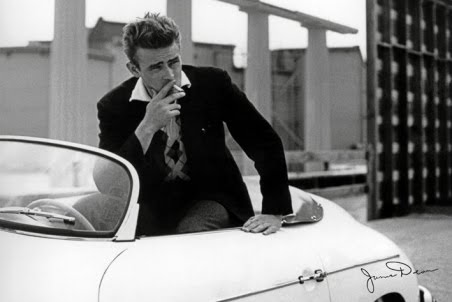
Had James Dean the superstar actor survived a horrific car crash in 1955 he would be 75 years young, or there abouts . . . have I unknowingly shared some common ground down the years with Dean over his choice of wheels . . .

James Dean loved speed — and so do I, I must confess. It seems to go with my part-time job of being a motoring journalist, I suppose. During Dean’s short lifespan of 24 years — before his meteoric career as a film actor came to an abrupt end when he was killed in a fiery car accident — he had managed to experience — as I did — the art of motorcycling via a Triumph Tiger 100 but soon made the logical jump to sports cars when he bought himself a red MG TD Roadster in 1954. (I no longer have motorcycles, but only recently got rid of my red MG TD, but that's another story!)

Alas, for Dean, the MG wasn’t fast enough and being quite a useful club racer, usually finishing in the top five places, decided a Porsche 356 was the car to take him to the top of the winner’s rostrum, and so it was — for a while. The appreciative crowds at Santa Barbara, Palm Springs and Bakersfield — circuits as well known in California as would have been our very own Roy Hesketh, Woodmead and Killarney are to South Africans — loved the good-looking star of “East of Eden,” a film that had set Dean’s acting career alight.

Back to Dean’s motor racing career and again his car was losing out to the opposition . . . it was time to find something really quick this time around. A Lotus 9 racer was seriously considered but the delivery time remained uncertain. A Morgan Plus Four (a car I also owned, but that’s worthy of yet another story) wasn’t rated rapid enough for Dean.

A phone call from a sports car dealer called Competition Motors in Hollywood, and on the advice of his motor mechanic and friend Rolf Wutherich, Dean fell in love with a Porsche 550 Spyder — chassis number 550-0055. This was one of a handful of Porsches earmarked for the American market that year — a car Dean was to own — but never race — just a few days before he met his untimely end.

Because of his yearn for speed, his studio executives had placed a ban on his racing exploits until another blockbuster movie was safely on celluloid — the title of the fim: “Rebel Without a Cause”. If he wasn’t famous already, he certainly was now!

On September 21, 1955 — two weeks before “Rebel Without a Cause” was released to theatres across America Dean took delivery of the $6,090 Spyder — quite a sizeable amount of money for a car back then. Mind you, it easily outperformed the 356 by offering 40 more horses and a top speed of 135 mph. This little car — nicknamed by Dean’s friends “Little Bastard,” seemed, somehow, to have a mind of its own . . .

Just before 6 pm on September 30, Dean and Wucherich in the Porsche Spyder crossed an intersection near the town of Cholame on Route 41 when, on their way to their first race collided with a big, solid Ford Custom coupĂ©  . . . well you know the rest.

Amazingly Wucherich and the Ford driver, Donald Turnupseed survived the crash, but not Dean. He was pronounced dead where he lay. The battered aluminium coachwork of the Spyder was past salvaging but many of the mechanical parts were sold on.

Legend has it that parts fitted to other 550s were somehow tainted with death, and it’s reliably documented that at least one race driver, a Dr Troy McHenry, lost his own life just 12 months later when driving his own 550 Spyder, ran into the only tree at the Pomona race circuit. Cause of the accident: a steering component — a part believed bought cheaply from Dean’s wrecked car.

Was this the start of what was to become known as the Cholame Curse? A car enthusiast George Barris, bought what was left of the wreck but the car slipped off the tow truck breaking both his legs while being unloaded. The malevolent Spyder seemed to be evil. When Barris broke the car up for spares he sold two rims and tyres only to learn both tyres had blown simultaneously sending the competitor into a wild spin and missing death by inches.

Barris loaned the wreckage to the California Highway Patrol for a display and later learned the garage where the car was stored had been burned to the ground along with several squad cars . . . but not “Little Bastard!” Many years later in 1983 and 1985 it seems the fans still hadn’t forgotten James Dean. His headstone was twice replaced after mysterious removal. What happened to the car, you might ask. Well, in 1960 another road safety show took place in Miami, Florida.

The remains of the car were loaded onto a tow truck after the event only to disappear en route to Los Angeles. “Little Bastard” was never heard of again.