Diesel price average price for Cape Town, November 2013

BP at Main Road, Muizenberg, Cape Town: R13,10 per litre (50 ppm)

In a typical 35-gallon barrel of light, sweet crude oil the potential is there to make about 16 gallons of petrol, 8,5 gallons of diesel, 3,4 gallons of jet fuel and 8,5 gallons of heavy fuel oil, liquefied petroleum gases and other products...all for around $80!

Tuesday, April 23, 2013

Diesel particulate filters


Filtering out the bad and ringing in the new
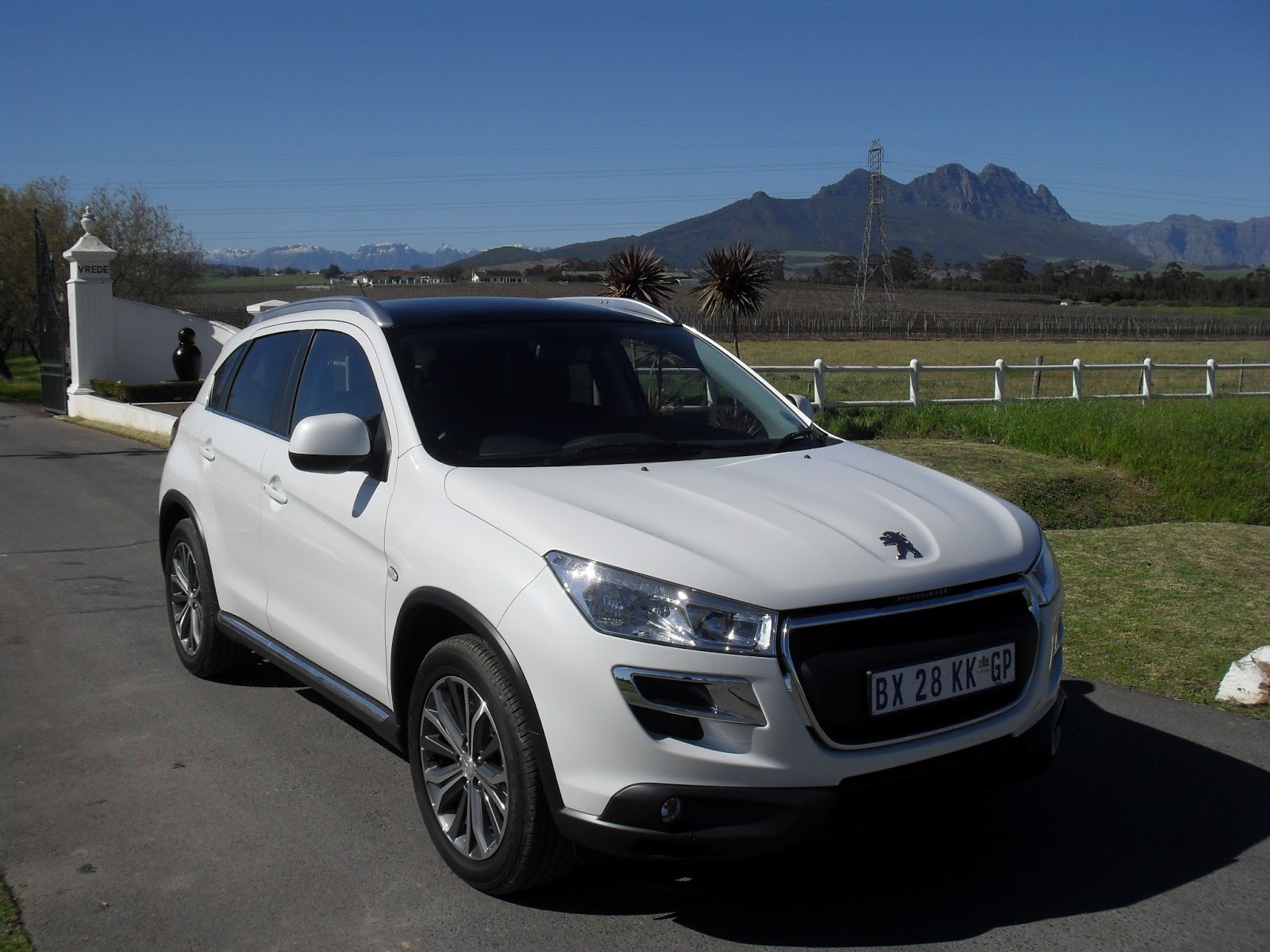


A number of years ago I wrote the following article for Peugeot South Africa. It still has much relevance in today's motoring world of diesel.

Diesel engines are capable of delivering superb economy figures and therefore emit less CO2, making them less of a greenhouse-gas hazard. Frustratingly for most R&D engineers in diesel engine-building plants across the globe is the pollution problem they are then left with. But not so with the French PSA Group who are streets ahead in the design and manufacturer of the near-perfect particulate filter system.

South Africa is catching on fast to the advantages of global diesel technology - of that there is little doubt. With our huge roads network, and as per usual very little time to get from A to B, it’s no wonder we all need the very best cars, light commercial vehicles the First World can offer us so we can go about our daily business.

But have you ever stopped to wonder what actually happens under the bonnet of your mode of transport and more especially those supposedly harmful fumes via the exhaust pipe as they are expelled into the atmosphere? We have, and I’ve decided this month to take a much closer look at some brilliant technology that’s available to us, yet sits quietly in the middle of a Peugeot exhaust system so everyone will ultimately benefit . . .

I’m talking about the particulate filter that’s fitted to some diesel-powered cars and to every imported Peugeot diesel product that arrives here from France. The French call it “filter a particule” (FAP), a system that was first installed on their superb 607 common-rail, diesel-powered sleek saloons back in the year 2000. Today, that filtering technology is so advanced Peugeot are able to rightly lay claim to offering their customers “the cleanest diesel motors on the planet” right now.

For the past 25 years or so public opinion has led most governments across the globe to take firm action by way of legislation to reduce exhaust gas pollution. Back then the emphasis was laid squarely at the petrol engine for being the worst offender but the past few years has seen a significant upsurge in diesel power so they’ve also had to “fall in line.”

Andre Douaud, director of technology for the French automaker’s association CCFA was recently heard to say: “Diesel growth in Europe has always been steady but in France it has been simply amazing as that nation believed in diesels from ther word go. The two remaining challenges left for diesel engineers was to reduce significantly two particulate emissions that enter the atmosphere: soot and oxides of nitrogen (Nox*).”

The European Union’s Euro 4 emissions rules for 2006 have proved tough to comply with. Again the PSA Group appear to have come out as market leaders with their third-generation particulate filter (FAP). “We meet Euro 4 this year with advanced solenoid injectors capable of outputting pressures of 1,600 bar. In 2010 when harsher Euro 5 emissions are expected to be enforced it is heartening to report we are already well on track to comply,” said Philipe Bercher, deputy technical director for diesel systems at Delphi France.

As we alluded to earlier most of the “clever parts” are to be found within the particulate filter “canister”. But the main subject of this story leans towards the very best diesel particulate filter system (DPFS), the one available from the PSA Peugeot Citroen Group.

This third-generation, self-cleaning FAP has been especially designed to take care of those horrid black exhaust fumes that diesel engines are usually blamed for - and thereby bringing the measurements down to an acceptable level – as laid down by the latest Euro rulebook. (One also needs to remember that all this self-cleaning happens while on the move so has no negative impact on driveability. Yes, the FAP does need servicing – but only at 120,000 km intervals.)

The system implemented on Peugeot HDi motors is made up of the filter unit, a fuel additive subsystem and various sensors. A regeneration operation will then clean out the filter of trapped particulates, governed by software within a controller located in the engine bay.

Every 500 to 1,000 kilometres or so the regeneration process begins – unbeknown to the driver and occupants. Don’t be alarmed - it is completely transparent.  To ensure the “cleaning” is done properly Peugeot use a liquid additive stored alongside the fuel tank. Every time you fill up, a small amount of the additive is squirted into the main fuel tank.

Two to four minutes every 1,000 kilometres travelled is all it takes to destroy the grotty little particulates. They are heated up to a temperature of around 550°C inside the exhaust system’s FAP, and you once again become “a friend of the planet” for another 1,000 kilometres. No ash, no fuss, no bother!

This third-generation FAP is quite a complex piece of equipment. In a bit more in-depth detail, one finds the particulate filter consists a porous substrate (etched mesh surface) with thousands of “storage” channels that are closed at one end. Exhaust gases are able to pass through the other leaving particulates behind that are too big to enter and are now stopped dead in their tracks!

Looking at the bigger picture with these clean, fuel-efficient diesel type engines it’s again worth remembering and recording the alliance between the Ford Motor Company and the PSA Peugeot Citroen Car Company some seven years ago.

A 'smart' 2.2-litre common-rail diesel commercial vehicle engine with the ability to think for itself was recently announced, the latest stage of a Ford Motor Company/PSA Peugeot Citroën joint diesel engine co-operation agreement. With the announcement of this fourth phase of the agreement, they now have a full range of high tech, efficient and clean common-rail diesel engines servicing the needs of both parties. Joint investment on the new programme of common rail diesel engines for light and medium commercial vehicles totals €120 million. While the design was Ford-led, PSA engineers were involved at every stage of the engine's development.

Ultimately, all the cars powered by the new engine will be equipped with maintenance-free third-generation diesel particulate filter technology. PSA Peugeot Citroën will use additives-based PF technology that has demonstrated its robustness and efficiency on more than a million vehicles worldwide, while Ford Motor Company will use catalyst-based PF technology.

The maximum torque of this engine is 400 Nm reached at 1,750 rpm. A third-generation electrically-controlled variable geometry turbo was also developed for applications which do not require the bi-turbo ultimate boost at low engine speed. Electrical control enables precise, fast management of the turbo's variable geometry to optimize boost pressure at each engine operating point.

The co-operation between Ford Motor Company and PSA Peugeot Citroën down the years has proved to be a huge success so far, as engines from the co-operation now feature in vehicles in the small, medium and large car sectors (including large and small MPVs), and now commercial vehicles. This is a significant achievement, taking just eight years from first inception, and resulting in engines produced in large volumes. From the beginning of the co-operation to the end of 2005 more than four million diesel engines will have been produced for a number of different applications as part of this agreement, leading to an upgrading of capacity at the two major plants where the engines are produced.

The two role players clearly understand the importance of having a state-of-the-art commercial vehicle diesel engine which has not been derived from a car unit. For both companies, van sales play a crucial role in their sales success in Europe. Diesel engines have proved massively popular in Europe for many decades - indeed 95 percent of commercial vehicles sold on the continent are diesel-powered. For Ford Motor Company and PSA Peugeot Citroën, diesel popularity carries an even greater significance, as 98 percent of all their light commercial vehicle sales in 2004 in Europe were of diesel models - thus making the need for a class leading engine essential.

The trend is also evident in passenger vehicles. Today some 61 percent of the sales in the passenger car market in Europe are diesel variants, while in Austria, France and Belgium more than 59 percent of all new car sales in recent years are diesel-powered. This new engine will not just be the first engine specifically designed for light and medium commercial vehicles to be produced under the agreement, it also meets the latest Euro emissions requirements (mandatory for light trucks for 2006).

Environmental considerations and the need to produce 'green' diesel engines were uppermost in the minds of the engineering team for instance, this new engine produces just half the amount of Nitrogen Oxide emissions compared with the engine from which it was developed. Carbon Dioxide emissions are reduced by 20 percent and particulates are down by 40 percent.

The overall investment for designing and producing the new 2.2-litre HDI/TDCI engine reached €212 million. R&D expenditures amounted to €127million while production investments for the new engine totalled €85 million, of which €54  million is for the Trémery plant. The carefully managed budget reflects the use of existing production tooling, with the only addition of very specific required improvements.


*Nox. This is a collective name for NO (nitric oxide) and NO2 (nitrogen dioxide). These substances are mostly formed at combustion temperatures above 2,200°C, which is about 300 degrees less than the maximum temperature of the burning fuel. Most engine designers reduce the combustion temperature by recirculating some of the burnt exhaust gases through the combustion chamber a second time, thus cooling most of the gas down to below 2,200°C. This system, known as EGR (exhaust gas recirculation) can be found on both petrol and diesel engines.

A vacuum or computer-controlled valve in the exhaust pipe is used to regulate the timing and amount of exhaust gas returning to the intake manifold. This is, incidentally, only done at low or medium power demand, never at maximum power or during idling, so that it doesn’t affect the maximum power output of the engine.

However, this system does have a disadvantage and that is the amount of carbon that gets deposited inside the intake manifold. This quantity obviously varies with the type of driving, but on some engines the manifolds have to be cleaned out about every 40,000 km.


Saturday, March 30, 2013

Mitsubishi Triton SE


Torque of the town


If there’s an underrated one-tonne bakkie (pick-up) in the marketplace right now it must be Mitsubishi’s Triton range. I had the pleasure of using one recently and can only sing praises for its ability to do everything well – even a well-known 4 x 4 track in the Cederberg area failed to seriously hamper its progress through the loose sand.

This particular single cab version code-named SE sells for R239 900 – yes I know there’s probably cheaper around if you consider some of the Chinese imports we have been inundated with of late – but as far as I can tell they’ve yet to prove themselves – certainly don’t seem to see that many on our roads, in fact!

South Africa really is bakkie country – especially now that our roads are seemingly deteriorating so fast – because there’s little money for such trivials, it seems – so bakkie ownership certainly makes lots of sense with its tough suspension, wheels and tyres capable of taking real punishment when and if …

Thankfully the Triton SC, as tested, boasts a rear diff lock as I was about to take her to a real 4 x 4 off-road circuit called Klein Tafelberg* in the Redelinghuys region of the Western Cape. The engine power (100kW @ 4000rpm/314Nm@ 2000rpm) is a real beauty and was always going to prove a winner. Close to being stuck in really loose sand she always pulled through – albeit with a little help from my friends!

On the open road the motor propels the SC along at the national speed limit – and then some, should your wallet be big enough! Speaking of which, the load bin is arguably the biggest (longest) in the SA marketplace, ie: 2200mm long, 450mm high and 1750mm wide. The model I had came standard with a tonneau cover and a roll-over bar – thankfully never needed!

Moving inside, the cab was a really great place to be. Three adults can sit fairly comfortably – though better suited for the wife and I and our faithful Yorkie companion, Roxie. There’s a little space behind the seatback(s) where the jack, wheel spanner, safety triangle are to be found, for frugal (slim) amounts of luggage.

Would I recommend one? You bet I would!

*Stephen Burger is the owner of Klein Tafelberg, 082 558 4575.


Specs:
Mitsubishi Triton SC one-tonner
Motor: 2.5-litre, turbodiesel
Power: 100kW@4000 rpm
Torque: 314Nm@2000 rpm
Fuel tank: 75 litres
Seating capacity: three adults
Load capacity: 1 ton
Towing capacity: 1500kg
Suspension: High-Rider, (F) Ind. Double wishbone, coil spring
(R) Rigid elliptic leaf spring/heavy duty susp.
Transmission: 5-speed manual; rear diff lock
Comfort features: 2-speaker sound system, power windows and air conditioning
Safety: Dual airbags, ABS brakes, EBD, Immobiliser, impact bars in doors, three-point ELR seatbelts
Price: as tested, R239 900

Monday, February 25, 2013

Headlights and more!


Lightly does it!


The modern-day car is an amazing piece of machinery. We are brought up to accept that we can’t manage without them, and that’s largely true. As with all things mechanical (and electrical) they do occasionally pack up and can leave the do-it-yourself enthusiast quite frustrated when the apparent simple task of changing a globe becomes a three-hour nightmare.

In 2008, is it perhaps a task best left to the staff at your local garage? You decide.

Before cars came along we had horse-drawn carriages. On the posher models one would have found gas lamps powered up by Colza oil — or something similar — for those occasional night-time excursions.

About 90 years ago acetylene lamps were considered “state of the art.” Powering them up was quite simple: dripping water was directed on to a lump of calcium carbide and a simple gas occasioned that when lit produced a good, steady white light. Perfect for the speeds that those early cars could manage, methinks.

Wars usually have a habit of motivating people’s minds to achieve great things in their hour of need, with military/commercial lighting kits soon being made available (once hostilities had finished) for civilians via a four-volt, 50-amp accumulator (battery) direct-lighting system.

Factor in the revolutionary dynamo that was now a regular feature of an automobile engine for charging the battery, and the motorist could now safely — but surely — travel at night — if he wished.

Between the Kaiser War and the Hitler debacle a headlight “dipping” system had been thought up to prevent dazzling on-coming drivers — usually found in the form of a push-pull vacuum pump or a solenoid that would activate the “split” reflector inside the “nearside” headlamp shell.

Around the same time the seven-inch headlamp become rather fashionable (and still is) . . . and then our troubles started!

Car wiring harnesses soon became more complex and complicated and would often feed an optional pair of spotlights up front, or maybe a large, central “driving lamp”. To change a broken globe all one had to do was remove the outer rim, carefully part the rubber seal and the numerous clips and then you could detach the offending, burnt-out globe.

But the point I’m trying to make here is it could be done by just about anyone, with the minimum amount of cursing and broken fingernails! Today, sadly, one needs to think twice before attempting this simple task.

A motoring colleague recently remarked: “You need the grip of a vice, the patience of a saint and abilities of a gynaecologist” — as he attempted to change the insignificant flasher globe attached to the wing of his ultra-modern, imported, French automobile.

He, like me, is totally convinced car plants across the globe (excuse the pun) either employ people on the production line with very small hands with a much depleted total of digits, or maybe they are simply double-jointed. (More likely they are ex-Cirque du Solaire circus performers who are adept at fitting themselves inside suitcases or small boxes and then closing the lid.)

Seriously, the next time you see a car coming towards you with a faulty headlight, or following one with it’s tail-light extinguished, have a certain amount of sympathy for the owner instead. Apart from the exorbitant labour cost that garages seem capable of charging these days to fix the problem, that replacement globe cost could well be the bigger part of the final bill.

Amazing, but it’s true!

Saturday, February 23, 2013

Fiat Qubo


Quirky but likeable Qubo


Born out of the Chrysler/Fiat liaison the Fiat Qubo has been eagerly awaited for some time now by faithful Fiat customers, fans and indeed the global motoring press … an event that should prove a winner from this stylish newcomer.

At the press ride-and-drive earlier this week we were able to sample the Qubo – in petrol and turbodiesel form – by virtue of this particular website leaning perhaps more favouraby towards the diesel offering, most facts and figures quoted will apply to the TD model.

The new Qubo may initially seem a little quirky for some tastes but considering its size it certainly packs quite a punch – and I’m not just talking about the fitment of one of the best 1.3-litre turbodiesel powerplants around. Fiat reckon on a 1 000km tank range offering, and I don’t doubt their claim for one minute as the fuel gauge barely moved on the ±200 km round trip in and around the Mother City here in South Africa.

Yes, it would very possibly make a superb “mom’s taxi” but the Qubo is far more than the sum of its parts. Empty nesters and maybe those who like to go on road trips – as I do – I guarantee you couldn’t do it cheaper – unless you happen to fly!

The Qubo is super comfy for the whole family, can carry a huge amount of gear – in fact, Fiat reckon the boot measures 330 litres (up to the height of the boot panel) and 650 litres if measured to the roof. With the rear seats removed and the front passenger seat folded down to the floor, the load capacity amounts to a best-in-class 2 500 litres, and a boot capable of holding objects nearly 2.5 metres in length, which, in comparison to the vehicle’s total length of 3.9 metres represents a ratio that is unmatched by the competition.

Talking about competitors, Fiat perceive there’s the Toyota Avanza, the Nissan Livina, Honda’s Jazz and Kia’s Soul – but none can match the Qubo’s extremely high specification level and ticket price – by any stretch of the imagination.

South African “anoraks” will want to know more about the mechanics of the car, well, it’s available with two Euro 4 engine derivatives: the lively 1.3, Multijet turbo-diesel engine and the reliable 1.4, petrol offering. That turbodiesel motor produces 55 kW at 4 000 rpm and offer hefty torque figures of 190 Nm at 1 750 rpm, guaranteeing satisfying performance along with the best consumption figures in its class. Maximum speed is 155 km/h and in the combined driving cycle it will return 4.6 l/100 km, according to the manufacturer.

Safety equipment includes ABS complete with EBD, 3-point seat belts with tensioners and load limiters, power steering, and front and side airbags. Available in 10 vibrant colours including Ambient White, Funky Orange, Line Blue and Breakcore Red, as well as six metallic; Minimal Grey, Hillbilly Azure, Flamenco Red, Disco Green, Cool Jazz Blue and Rockabilly Black.

• Fiat’s new Qubo is available ex-stock from any one of the 36 Fiat dealerships countrywide and, as with all Fiat Group products, comes standard with a 3 year/100 000km full maintenance plan and warranty for peace-of-mind driving. The Qubo ticket price is  R177 990 for the 1.4-litre petrol version, and R199 990 for the 1.3-litre diesel variant, including VAT and CO2 tax. Servicing is only required at 30 000 km intervals.

Sunday, January 20, 2013

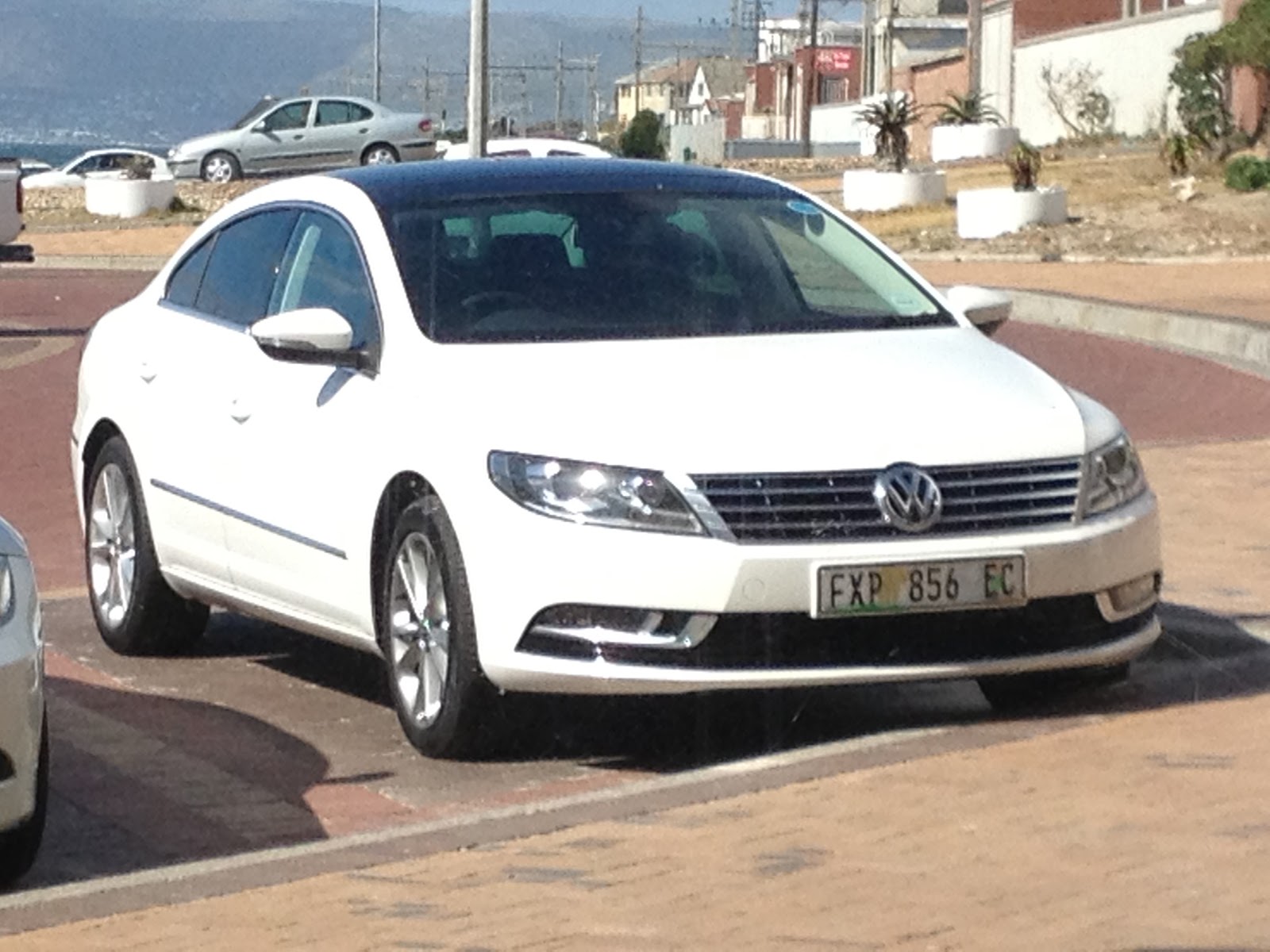
VW 2,0 TDi CC


CC Signor, says Volkswagen 


My goodness, but Volkswagen certainly appear to offer the complete range of cars these days – 134 different models at last count. Are we spoilt for choice in South Africa … we certainly are!

In among that mix of fine cars is a triumvirate of them called CC, launched around the middle of last year. There are two petrol derivatives (a two-litre TSi (155kW) and a 3.6 V6 4Motion DSG (220kW) and a 125kW turbodiesel – but for me, the pick of the bunch is the two-litre TDi model with Bluemotion Technology and DSG that I was able to run around the Mother City this past week.

This model is equipped with Bluemotion Technology with stop/start technology, but this particular CC is certainly no slouch and can accelerate to 100 km/h in 8.6 seconds, while a top speed of 220 km/h is possible. VW claims fuel consumption figures of just 5.5 litres/100 km (144 g/km CO2).

The on-board computer carefully scrutinised while driving the car certainly came very close to those suggested factory figures.

 Hein Schafer, product manager for VWSA, told me at launch: “The CC’s redesign – which incidentally stands for Comfort Coupe – can be seen from the back to the front of the vehicle and represents a precise and ideal styling and now falls in line with VW’s instantly recognisable design DNA, such as the chromed radiator grille with its three cross-fins. Also to be found are a new front bumper and bi-xenon headlights.”

VW also reckon the TDi version is most likely to be the volume seller, with its common-rail diesel mill that pushes out a strong 350Nm of torque available from just 1750rpm. At launch I discovered that there is but a single gearbox across the range: the dual-clutch gearbox (DSG).

 Love it or hate it, this box certainly offers maximum economy coupled with seamless gear shifting. While it has the potential to reduce fuel consumption and emissions, it’s interesting to note, compared to an auto with torque-converter clutch, VW claims a fuel-saving potential of anything up to 20% – depending on your choice of engine.

The 2.0 TDI DSG sells for R387 600 
(at the time of going to press) and comes standard with a five-year or 100 000km AutoMotion maintenance plan, three-year or 120 000km warranty and a 12-year anti-corrosion warranty. Servicing is only required at 15 00km intervals.

Saturday, January 12, 2013

Chev Cruze LT


Show and tell Cruze 

I’ve probably mentioned this before: but if there’s a brand available in the South African marketplace that’s doing really well, it has to be GM’s Chev. I’ve just spent a pleasant few days running their flagship model, the 2.0D LT Cruze around the Mother City here in Cape Town and what a really good car it is.

It’s well priced too, at R280 100, representing very fair value for money.  A recent revision to this model sees the 2,0 litre diesel engine has had its power increased from 110 kW to 120 kW together with 360 Nm of torque, up from 320Nm. Drive for the 2,0 litre diesel models is now via a 6-speed manual transmission for the LS version and 6-speed auto transmission for the LT version.

There’s also some erstwhile styling and comfort enhancements include a headlamp-levelling system; steering wheel mounted satellite controls for the audio system, plus cruise control. The turbodiesel version is arguably the flagship model in the five-model Cruze lineup, a model that’s currently enjoying great reviews elsewhere in the South African motoring press.

On researching this particular vehicle it’s interesting to note that the 2.0-litre diesel engine is all new: double overhead camshaft, 16-valve, intercooled turbo diesel – with electronic control of the turbocharger – and high pressure common rail fuel injection system. This engine produces 120 kW @ 4000 rpm (up from 110 kW) with maximum torque of 360Nm delivered at just 2000 rpm (increased from 320 Nm).

The Cruze is well-named, the car is so easy to drive. The six-speed gearbox has well-spaced ratios; the national 120km speed limit is easily reached while the rev counter reveals the motor is spinning over at a lazy (and ultra-economical) 2000 rpm.

Creature comfort levels are particularly high as are the safety levels to be found, such as multi airbags, ABS brakes and various computer driver aids such as traction control working their combined magic in the background every kilometre of every journey. Factor in leather seats, dual zone climate control air conditioning, rear park assist, rain-sensing wipers and an auto lights on function.

• The Chevrolet Cruze is covered by a five year/120 000 kilometre warranty with a five year unlimited anti-corrosion warranty. Service intervals are 15 000 kilometres. A three year/60 000 kilometre Service Plan is included in the purchase price.

Tuesday, December 18, 2012

Nissan Qashqai


Qashqai comfort zone

Nissan’s Qashqai crossover – especially the 4 x 2 diesel version – left me gobstacked over its economy capabilities … 850 kilometres travelled and still a quarter tank left! With nine models of Qashqai up for grabs, and with prices starting at R243 590 (correct at the time of going to press), this vehicle represents very fair value for money.

An enigma that often leaves me puzzled is the fact that when you drive a different type of press car you see lots of similar models to the one you are driving. And why not, because Nissan has South Africa covered, I reckon. The Qashqai does everything asked of it and more …

Considering it’s a full import they are very well priced, being built at the Nissan car plant in Sunderland, northern England. Launched back in 2007 it’s become a top-selling mainstream model in the South African marketplace – and remains a firm favourite in the UK’s top 10 best sellers list.

Roomy, well made and user friendly – I’ve already told you it’s ultra-economical – the cargo area is vast; fold down the seats and you’ve got yourself an instant station wagon at no extra cost. It’s a good looker, too.

Creature comforts abound with all the usual power stuff but I did enjoy using the simple to use and intuitive Bluetooth phone connection. Why doesn’t every new car come with ‘hands-free” capabilities in this day and age? There are most certainly  more expensive cars out there that make this particular feature an optional extra … what a damn cheek!

Jim Wright, managing director of Nissan GB told me: “Cars that are desirable when new are still desirable when the owner comes to sell them on, especially if they have proven to be reliable. The continuing success of the Qashqai in the new and used car markets proves that the British and South African motor industries can produce a winner, even in the toughest market conditions.”

• Nissan Sunderland Plant manufactures the Nissan Qashqai, the Nissan Note and the Nissan Juke and will manufacture the 100% electric Nissan LEAF from 2013.
• Production of lithium-ion batteries for electric vehicles begins next year.
• Total plant volume since 1986 stands at more than six million units
• Total investment made and announced since then is £3.3 billion
• In 2010 81 percent of production was exported to 97 markets worldwide
• Sunderland Plant currently employs 5,000 staff